
On Friday, September 8th, 1995, Mary Shortt was following her younger brother Chris through Clearwater, trying not to lose him as he dropped his car off. He made a traffic light. She did not. In the years before GPS and cell phones, the separation was enough to create a small panic in her: it was getting late, she did not know where she was going, where he would stop, or how they would find each other again.
R.E.M.’ “Reckoning” was playing over the radio. Then, without warning, another sound entered the moment—not through the car’s speakers, Mary believed, but from memory, intuition, or somewhere she still cannot name. It was Jack Vigliatura’s voice.
“Out of nowhere Jack’s voice dropped in my head,” Mary recalled. “It was 100% his voice, and what makes it so relevant is that I 100% wasn’t thinking about Jack. I was thinking, ‘How am I going to find my way home because I don’t know where I’m at. But I distinctly remember hearing Jack’s voice and he said, ‘I’m sorry, Mary.’ It shook me for a minute and I just kind of looked straight ahead.”

Mary and Jack had not been in close contact for months. His band, For Squirrels, was touring; he had been recording its major-label album, Example; he was preparing to marry Kim Bashford. Mary was building a life with Jeffery Stringer, the man who would become her husband. Yet Jack’s voice came to her with such clarity that she noticed it, questioned it, and remembered it.
That same Friday, September 8th, For Squirrels was driving south after a CMJ Music Festival performance at the legendary CBGB in New York City the night before. On their way home, a tire blew on Interstate 95. Their van overturned three times. The official band biography preserves the stark facts of the crash: Jack, bassist Bill White, and tour manager Tim Bender died. Guitarist Travis Tooke and drummer Jack Griego survived, but with serious injuries.
Mary did not know any of that while she sat behind the wheel, listening to R.E.M. and unsettled by a voice that seemed to cross an impossible distance. She only knew that for a moment Jack was there, apologizing. The knowledge came later. The meaning has never stopped changing.
The White House at Powerhouse
Years before that final echo, Mary first heard Jack’s name in the charged, whispering way teenagers hear about someone everyone else has already noticed.
Mary and her younger brother Chris had not grown up in a religious household, but in 1989 she began attending Countryside Christian Center as a freshman at East Lake High in Tarpon Springs because her best friend wanted protection from the social pressures of a crowded youth group. Mary called herself the safety net, but she needed one too. Quiet to the point of invisibility, she and her friend usually stayed within their little bubble.
The youth group was called Powerhouse. Its meeting place was an old, white house on the church grounds, gutted to make one large room. In the summer before Mary’s sophomore year, the group traveled to a week-long camp in Lakewood, Florida. Jack, who was born John “Jack” Francis Vigliatura IV, was there. Mary did not know Jack, but the other girls were all talking about him.

Their first conversation happened in a cabin. Mary sat on the top bunk with two girls when Jack walked in, apparently just to say hello. He asked about school and her classes. What Mary remembers most is not what he asked, but what his presence allowed her to do.
“You have to understand that I am painfully, awkwardly shy, but in that moment I actually surprised myself because I was actually able to hold a conversation with him and held eye contact, which was not normal for me to do,” Mary said.
The retreat supplied a second introduction, this one comic. Girls raided the boys’ cabins, gathered stolen clothes, and wore them around camp as though nothing had happened. Jack’s mother had labeled his clothing, so the girls assigned his outfit to Mary. For someone who thought of herself as incapable of boldness, putting on his clothes was another small act of courage.
Jack laughed. The prank did not humiliate him; it amused him.
Once school resumed in the fall of 1990, they barely interacted. Jack was heading into his senior year. It was after Mary attended a church service, raised her hand to the heavens and made a personal commitment to her spiritual faith, when they spoke again. Jack hadn’t forgotten her and the next day at school, he sought her out in the hallway to acknowledge the significant moment in her life. “He just seemed genuinely happy for me,” Mary recalled, and a fellowship of Christian Students club finally gave their friendship a setting. Jack sat beside her. They talked and listened to music. Because they lived near one another, they rode home in the same church van.
“Music and Christian faith were the foundation for us,” Mary said. What began in a cabin, continued through a prank, and deepened in a school hallway now acquired rhythm through meetings, rides, conversation, and songs.
There was a third foundation, one she would understand fully only after Jack left for college: writing.
Pump Up the Volume
Music gave Jack and Mary a language that did not require her to become someone more outspoken. “Music was our biggest connection, our biggest talking point, our biggest thread.” Jack came to her house, and they watched MTV’s 120 Minutes, the late-night window into alternative music. He did not merely recommend bands, he transmitted a feeling of discovery.
One crowded ride in the church van fixed that quality in Mary’s memory. Sitting on the floor near Jack, she noticed handwriting on a folder and read the words aloud: “Standing on the shoulders of giants leaves me cold.” Jack explained that the line came from R.E.M.’s “King of Birds.” Mary did not retain his exact explanation, but she recalled his delight. The scene also contained classic Jack chaos; he should have been at soccer practice and had to scramble for transportation after the van dropped him home.
R.E.M. became a central influence, but never the only one. Jack introduced Mary to the Pixies, They Might Be Giants, the Stone Roses, Smashing Pumpkins, Jane’s Addiction, Billy Bragg, fIREHOSE, Indigo Girls, Mazzy Star and The Sundays. Mary heard those influences inside For Squirrels without believing the band merely imitated any of them. “I never once thought it was just a copy and paste situation,” she said of the comparisons often made between For Squirrels and R.E.M. “I thought the lyrics were unique to For Squirrels and Jack.”
Their friendship lacked the aloofness or formality some have for the opposite sex. Jack teased Mary about the boys and claimed that anyone she refused to identify with must have a strange deformity. They went to homecoming together.
“Jack didn’t have a car when I met him and neither did I,” Mary recalled, but their friend Andy Lord, one of Jack’s soccer teammates, did. The three friends often went to Harbor Island because walking around cost nothing. “We’d do pretty much the same thing every time,” and when Andy was driving their soundtrack never changed: U2’s The Joshua Tree, forward and backward, again and again.
“Those drives were memorable for me,” said Mary. “When I hear that U2 album today, it always reminds me of those times back then.”
When Jack finally acquired a baby-blue gray compact car he grandly named Gorby’s Transmission, he offered Mary a crash helmet before their first ride and her mother urged her to put it on. Mary, mortified, refused. Jack wore the helmet for his own amusement and what he hoped would be hers, before eventually taking it off during the ride.
That fearlessness carried onto a stage in front of hundreds of people. At East Lake’s talent show, Jack performed the Church Lady from Saturday Night Live, complete with a homemade paper backdrop and stained-glass window drawing. “It was mesmerizing,” Mary said. “He had everyone laughing.” The captivating performer who would front For Squirrels was already visible, but Mary also knew the person behind the performance – the friend patient enough to understand silence.

He and Mary drove Jack’s family’s minivan to a Sears auto repair shop at some point in late 1991, and while Mary doesn’t remember the specific repair the car needed, she does remember the conversation on the ride there. Jack waited impatiently for the radio to play a new band he was excited for her to hear: Nirvana.
He kept insisting the song “Smells Like Teen Spirit” from the album Nevermind had to be coming. When it did, Mary watched his face illuminate and his body shake with excitement. It was the physical response of someone hearing possibility.
“After hearing it I could see why Jack was so excited,” Mary said. “I had never heard anything like that before.”

Jack loved The Cranberries with equal seriousness. When No Need to Argue arrived, which included the hit track “Zombie,” Jack, Mary and his younger sister Anna lay on the floor, listening and dissecting songs from an album that was released on October 3rd, 1994. Little did any of them know this was exactly one year to the date that For Squirrels’ Sony 550 album Example would be released. His taste made room for Tracy Chapman and Sting as readily as guitar-driven college rock. Mary’s summary was simple: “Jack just loved good music and all different types.”
On November 21st, 1994, he picked Mary up on her birthday and took her to the midnight release of Pearl Jam’s Vitalogy at a Spec’s Music store in Tampa. She still calls it her favorite Pearl Jam album. The memory contains no grand declaration. Its meaning lies in attention: Jack knew what music mattered to her, remembered the date, and showed up. Neither of them realized it would be one of the last times they shared a powerful music moment together.
The Weight of Expectation
Jack’s intensity could be funny until it became frightening. At an away high school soccer match, he and another player rose for a header and collided. The other player’s head struck Jack square in the eye. By the next school morning, the rumors had managed to outrun him through the halls and students kept telling Mary that she needed to find him.
She did, and was shocked to find his eye was black and blue, swollen shut. Because he wore contact lenses, the emergency-room doctors had to pry the eye open to remove the one trapped inside. His parents woke him repeatedly overnight because of concussion concerns. Meanwhile, Jack treated the gruesome injury and its perils as a spectacle. He reveled in it. “People are recoiling from me in the halls, it’s hilarious,” he told Mary. She concluded, with understatement, that “Jack was tough!”

The toughness went beyond athletics ability. Jack was the oldest of five children—followed by Anna, Faith, Rebekah and Mark—and family responsibility shaped him. Perhaps it was evident in a family of seven living in a two-bedroom apartment at Countryplace Apartments in Palm Harbor, but it wasn’t until later that Mary later learned of the Vigliaturas’ financial hardship. What she saw in real time, day-to-day, was cohesion. “They were a strong family of faith. They projected an aura of love,” Mary said. Jack helped because helping was not presented to him as optional, nor did he regard it as a chore or punishment. “It was never a burden to Jack. It was an honor and responsibility to him.”
Before college, he searched for odd jobs. Mary’s parents hired him to remove invasive weeds from the pond behind their house. Jack brought his father over to help determine a fair price, then did the labor himself. Mary sat beneath a palm tree with summer math workbooks while Jack raked the pond and encouraged her studies. At one point the rake flew from his hands and sank. Jack panicked, embarrassed that he had lost the tool. So, Mary became the encourager. “No, no, don’t worry, Jack. It’s fine,” she remembered telling him.

During college breaks, he handed out samples at a Japanese restaurant in the Countryside Mall’s food court. Mary recalled that the owner valued Jack’s ability to attract teenage customers through charm and outgoing energy. These jobs were modest, but his approach was not. “He just had an amazing work ethic,” Mary said. “He was very focused and driven. It just didn’t seem like there was anything Jack couldn’t do.”
When Mary first met Jack’s Italian American family, she was immediately struck by the warmth of his mother, Karen. She affectionately called her son “Jackie,” a nickname also used by others who were closest to him.
“Jack’s mom was just the nicest, sweetest person, very warm,” Mary recalled. “Just super nice and kind. She always made you feel comfortable and welcomed. In hindsight, I can see how Jack had that, too. I could see that he got that from his mom.”
By the time For Squirrels had recorded Baypath Road and begun work on Example, the band was playing to a sold-out crowd at the Covered Dish in Gainesville. With many members of Jack’s family watching, the opening notes of “Flagboy” rang out. Then Jack launched into the chorus: “Make your momma proud … oh, the body of the flagboy has been found.” That night, the lyric seemed to gather every thread of his life—his fascination with history and the Civil War, the work he had done to help his family, and his fierce determination to carry For Squirrels toward success.
Beside Jack’s mother stood his uncle, Bruce Gordon. Over the music and the roar of the crowd, he heard her answer the lyric softly: “Oh, you did, Jack. You really did!”

But at home, the person whose approval mattered most was the venerable Mr. Vig.
Mary’s first meeting with Jack’s father began with a peculiar question: “So, what are your intentions with my son?” She froze. “That was terrifying,” she said, remembering how, “I had never heard a question like that before. It was pretty jarring. I probably came off like a mute or something because I didn’t know what to say.”
Jack defused the situation by drawing attention to his battered glasses, which were heavily worn by time and resting lopsidedly on his face. When Mr. Vig saw Jack, he turned back and asked Mary, “So this is who you want to spend your time with?” Father and son laughed, revealing that Mr. Vig’s seriousness could bend without disappearing.
Jack respected his father’s expectations. “He wanted to please his father. He was going to toe the line to make his dad happy,” said Mary. Mr. Vig valued purposeful motion. Jack, an international business major studying German at the University of Florida, seemed equipped for a secure and ambitious career. Music looked uncertain, especially to a family familiar with economic insecurity.
The family’s financial hardship – and Jack’s hope that the band might alleviate it – is a recurring motif in their music. In “Disenchanted,” this struggle is highlighted by the lyric about securing an endless supply of milk, a poignant symbol for a basic necessity that was likely a luxury during his youth.

As For Squirrels grew serious, the disagreement between Jack and his father over Jack’s professional path increased in tensity. The turbulence found expression in the sixth track on Example, a song ignited by Travis’ chaotic guitar riff and later shaped by Jack’s lyrics and impassioned vocals.
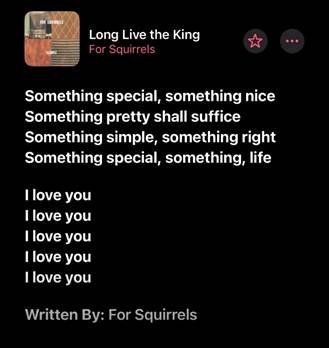
“It was pretty obvious that ‘Long Live the King’ was about Jack Senior,” Mary believes.
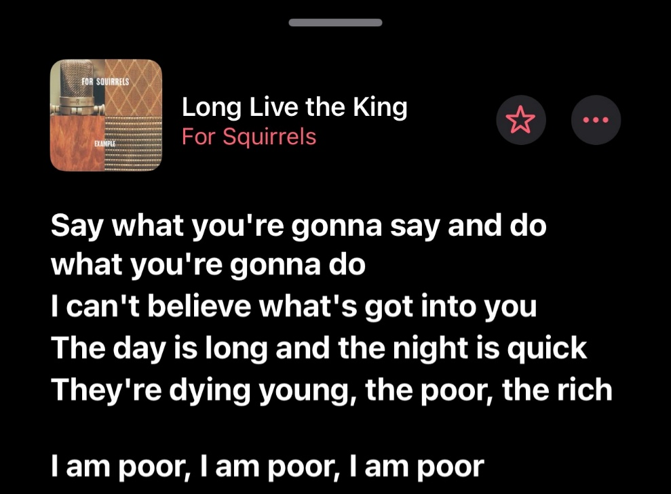
For Squirrels purposely didn’t publish lyrics with their albums, largely because they wanted listeners to interpret the songs and meanings for themselves. People could hear the songs differently, and no one would necessarily be wrong.
That interpretability is why it can be tempting to conclude that a few other For Squirrels songs were inspired by Jack’s relationship with his father. “Kill the Birds,” for example, includes lyrics that appear to support that notion. However, some of the people interviewed for this project said the lyrics for that song, which are sung by both Jack and Bill—both devout Christians—could also have been inspired by something else.
“I interpreted the lyrics to ‘Kill the Birds’ as a younger Jack singing from his perspective growing up with his dad,” Mary said. “Jack told me that there was a period when the church his family attended was legalistic, so I’ve always applied the lyrics of this song to that.”

“Go On Up,” which also appears on Baypath Road, could also be interpreted as a song about overcoming life’s adversities. Jack never told Mary what inspired the lyrics to “Go On Up” or the song itself. “That is not a song I ever recall having a conversation with Jack about,” she said. “I only recall it being one that, at the live shows, everyone would lose their minds over.”
Jack was building a résumé that could have pointed almost anywhere: international business, German sharpened with an eye toward the wider world, and, at the same time, being the lead singer of an up-and-coming indie-rock band. In short, he had options, but lacked a consensus on which path he should fully commit to.
“Jack could have been any of those things,” Mary said. “Makes total sense if you knew Jack. He also could have spent different phases of his life being each of those things. That would make sense, too.”
Mary reads his father’s reaction, now, less as opposition to Jack than fear for him.
“Some may see it as tough love, but I think Jack’s father just wanted security for their son. From Mr. Vig’s standpoint, there were loftier things afoot for Jack. They knew he could do many things and do them well. Jack was the total package. So, to Mr. Vig, it might have seemed like a waste of Jack’s talents to be messing around with the band. And given their own living insecurities, I think they just looked at it like, ‘No, you need to go more for the sure thing.’ Looking back at it all these years later with a family of my own, I think any parent could probably understand where Mr. Vig was coming from.”
When Jack decided to leave UF and commit fully to the band in 1994, he was nervous about the conversation to gain his father’s blessing. Mary does not know every word exchanged, but she rejects the idea that Jack manipulated his father. “Jack didn’t sell his dad,” she said. “He made a passionate plea to gain his father’s support to pursue his dream and passion. There’s a difference.”
The distinction mattered because approval, for Jack, was not conquest. It was love returned.
Letters from Gainesville
When Jack graduated high school in 1991 and left for UF, Mary remained at East Lake for two more years. Distance could have ended a high-school friendship built from rides and shared listening. Instead, for them, it only changed the medium.
Jack wrote letters by hand. Mary answered. On paper, she could say what shyness restrained in conversation. “Jack and I became closest during our letter-writing period,” she said. “That was the period when I felt like I could be the most honest or vulnerable.”

The letters carried stories from a life gaining speed.
Jack moved in with Travis and Bill, best friends from East Lake soccer. Travis and Bill had bought pawn-shop guitars and taught themselves to play. The three began making music for fun, then behaving as though fun might become vocation. Mary was not startled. “It just seemed totally natural and normal,” Mary said of learning the three friends had started a band. “I was like, ‘Yeah, of course he would do that.’”
What changed her sense of scale was Jack’s report that the band had rented a storage unit for rehearsals. A room dedicated to practice meant money, commitment and repetition. “That was a conscious decision to move the band forward and put more time and effort into it.”
The band tried names like the Fully Gnarlies, Lenny Kravitz Got Drafted and even Gorby’s Transmission before settling on For Squirrels—a pledge that if nobody listened, they would still play for the squirrels near the rehearsal space. Mary loved the band more than the name, but the name suited their stubbornness.
“I absolutely loved the band, the music, the lyrics … everything,” Mary said. “But I didn’t necessarily love the band name.”
In June 1993, Jack, Bill and Travis, with their first drummer Jay Russell, managed to get themselves booked to play a show back at their old stomping grounds: the East Lake Class of ’93 grad party. Mary was in attendance with her fellow Eagle graduates.
The guidance counselor at the school, for both Mary and Jack, lived across the street from Mary. When he visited her house, Jack made a few visits to the guidance counselor in hopes of getting For Squirrels booked for a live gig. Those efforts were successful, and according to Mary, the band didn’t disappoint at Grad Night.
“The students were very receptive,” Mary said. “I mean, everyone was dancing and going crazy. It was a great time and a lot of fun.”


Later that year, the vehicular Gorby’s Transmission died near the Archer Road exit while Jack and Mary were driving to Gainesville for his DJ engagement at The Covered Dish. Remembering a state trooper parked in the median, they walked back and found him asleep. Jack knocked; the snoozing officer jumped. Because the patrol car had only two seats, Jack took the passenger seat and Mary rode on his lap back to Gatorwood Apartments. Jack never made it to the DJ gig that night.
Jack stored his contacts in water and when he put them back in the next morning, his eyes turned painfully red. Mary, who had crashed on the apartment floor, said he looked “absolutely possessed.” That was a rough 24 hours for Jack, partly because Gorby’s Transmission never rode again.
The band did. Jack sent Mary a cassette labeled the Fully Gnarlies, with songs that were still taking shape. Later, For Squirrels used student-loan money to record Baypath Road. The album, named for the Massachusetts road of Jack’s childhood, was self-released in 1994; Jack had traveled back to his hometown of Spencer, Massachusetts for lyrical inspiration for songs on the album.

Jack picked Mary up in his parents’ minivan and drove while the completed album played. She sat and listened as he explained the songs. “It was exciting. I thought it was just excellent. It was so good. Looking back on it, I wish I had taken a pause to process a bit more because what they had done with that record was remarkable. I wish I would have articulated that to Jack better in that moment.”
By then, Mary and Chris, who was still at East Lake, made the two-hour trip to Gainesville whenever For Squirrels played. They slept on floors and couches at Gatorwood when necessary. “It was never a question of whether or not we were going to the show,” she said. “We’re going to support them.”
At the Covered Dish, she saw the action the letters had been detailing.
“It’s hard to describe if you never saw them live, but when For Squirrels played they were just excellent to watch and listen to,” Mary said. “They were really good at what they were doing together. The crowd always responded. With their music, you didn’t have to really think about anything, you just felt the music and you danced around and it was just so great. It was a great time.”
Jack continued to update her even as Rich Ulloa took For Squirrels on as their band manager in ‘94. He took singing lessons—not only to improve pitch and delivery, but to learn breath control and protect his voice. “Jack was prepared to do whatever it took to help the band succeed.” The progression Mary witnessed was not luck arriving. It was work accumulating.
An Example, Not a Stereotype
For Squirrels entered a rock scene that carried expectations about excess. Jack Vig, Travis, Bill, Jack Griego and tour manager Tim Bender did not fit the stereotype.
They were not interested in using the band as permission to drink, take drugs or make partying the point of their music. Mary understood Jack’s restraint partly through something he confided in her later in their friendship: in early high school he had a period of acting out; skipping classes, sneaking out, falling in with people who got in trouble. “I surmised that was a dark time for Jack and wasn’t something he ever wanted to return to.”
His faith was not a costume adopted just for church. “The Jack that was on the stage performing as the lead singer of For Squirrels was the same person I met at the church youth group,” Mary said.
Jack never forced his belief on strangers, but he did not conceal it. If someone mattered to him, he told that person he was praying for them. He and Mary discussed what they prayed for in each other’s lives and what those prayers meant.
“Jack’s faith was part of who he was from the very beginning of me meeting him,” said Mary. “I observed him to be a positive, encouraging person to everyone. He was not someone who would push his faith on anyone, but he was unapologetic and showed no fear in speaking up about his faith.”
At youth camp, Jack once tossed a pen into the air while asking a pastor about free will: if God knew everything, had God known he would throw it? The pen landed near Mary’s feet. She worried that picking it up might interfere with the theological experiment. Eventually she returned it. Jack accepted it with a warm smile. The scene captures the combination she called “spiritually intelligent and inquisitive.” Faith, for Jack, was sturdy enough to question.
That faith also appeared through conduct. Mary and Chris did not experience the secure family structure Jack knew. Jack sensed it and moved toward them rather than away. He included them, visited, asked about grades and goals, and offered encouragement where adults had not. “Jack was kind of like the family that we chose,” Mary said.

Chris, three years younger than Mary, responded to Jack’s energy and music. Jack did not treat him as an accessory to his friendship with Mary. He made himself available. For a boy who had been disappointed by important men, Jack became evidence that attention could be consistent.
The same impulse guided what Jack wanted from success. “Jack wanted the band and their music to make a positive impact on people,” Mary said. “He wanted to give people a proper example. Jack also wanted to give his parents a sense of security by providing for them.”
When For Squirrels signed its Sony 550 deal in early 1995, Jack used his first payment to buy his parents and siblings a house. “It was a surprise,” Mary recalled of the story Jack told her of buying his parents a home. “He just took them to it and said, ‘This is your new home.’ Jack was so happy to share the fruits of his labor with his family. Buying that house for them was huge. If that was all Jack was able to do financially because of For Squirrels, he would have been happy.”
The band’s major-label album, Example, was produced by Nick Launay and scheduled for release on October 3rd, 1995. Its 10 songs moved between explosive and melodic dynamics; the group described its goal as taking listeners to different places rather than expressing a single emotion. Long before Mary heard the finished record, she understood the apparently straightforward title’s moral weight. Jack did not merely want to tell people what mattered. He wanted to demonstrate it.

Everybody Hurts
Success altered Jack’s schedule, not his character. For Squirrels toured and established a following; Example was completed while national recognition drew close. While the band’s song “Mighty K.C.” would later become an alternative-radio hit, the record label had tentatively planned to release “8:02 PM” first, but the album’s October 3rd release would arrive after the crash.
Nearing the end, Mary and Jack saw less of each other. She was dating Jeffery Stringer, whom she would later marry. Jack had reunited with Kim Bashford, a girlfriend from high school. When he visited Mary’s house, he often came to see Chris. Mary last saw Jack in August 1995, shortly before his wedding.
Distance did not erase the old shorthand. When R.E.M.’s Monster was about to be released, Jack boasted that he had heard it early. Mary answered that she had too, then produced a promotional CD she had found in Ybor City. Mary had also seen R.E.M. in concert back in her home state of Michigan in June of 1995 a few months before R.E.M. was scheduled to visit St. Petersburg on tour – a show Jack and the band had tickets for. For once she had beaten the person who had introduced her to R.E.M. Jack’s surprise made the victory sweeter.

Jack’s final tour ended with a New York City show. The band then headed south. They wanted to be home in time to see that R.E.M. concert in St. Petersburg on Saturday, September 9th. The itinerary joined the origin of Jack and Mary’s musical education to its catastrophic ending. The band was racing toward the music that had helped start everything.
Mary eventually found her way home late on September 8th. After church, she and Jeffery returned to her house together. Her parents were waiting behind the door, their faces strange. They asked the couple to sit on the couch. Chris was in his bedroom with the door closed, staring at the closet door he had punched holes in hours earlier; Mr. Vig had already reached him by telephone. Then Mary’s parents broke the news to her.
“I was just numb and hysterically crying,” Mary recalled.
The contradiction in that sentence—absence and overflow—became the shape of grief. Jack, Bill and Tim were gone. Travis and Jack Griego were seriously injured, fates yet unknown. The future that had appeared so close was suddenly an artifact.
For Chris, the loss reopened every earlier abandonment. Jack had chosen to act like family, and then something neither effort nor loyalty could prevent had swept him away. “To have Jack taken away the way he was, being so young and having so much more life to live, it was brutal,” Mary said. She and Chris attended the funeral services for Jack and Bill in Palm Harbor on September 13th, 1995. That same day, Tim was laid to rest in Cary, North Carolina.
For Mary, the voice she heard on September 8th changed from oddity to enigma. “But then to learn that Jack was killed that same day, it took on a different meaning,” she said. She does not pretend to know what happened in that car. She knows only that she heard him, that she remembered, and that the apology preceded news no apology could contain.

The Lyrics Left Behind
Example was released as planned. Mary had heard several songs live, but not the finished album. Listening after the accident made production quality almost beside the point. “At first, it was very hard for me to even think about. It certainly wasn’t joyous,” she said. “That was a pretty devastating, horrible time. It was dark.”
When she could hear the record as music, she recognized an astonishing advance from Baypath Road. The sound was sharper, more polished, more assured. Less than two years separated the albums. “They made such leaps and bounds in a short amount of time,” Mary said. “It was impressive, but it’s also bittersweet.”
Even Baypath Road, once associated with a minivan, Jack’s commentary and the thrill of a completed dream, became painful. Mary still played both records, but sometimes as an instrument of grief. “If you wanted a good cry, you would put it on,” she said. Years passed before she could say, “Okay, I can listen to it how it’s meant to be listened to.”
When Travis and Jack Griego returned to performing, Mary wanted to support the reformed band, which now included Andy on bass guitar. She, Chris and Anna attended a St. Petersburg show, nervous but hopeful. The first For Squirrels song began—Mary thinks it was “Long Live the King” — and she and Anna immediately cried. The three of them left together.
Mary did not resent the surviving musicians for continuing briefly as For Squirrels before changing the band name to Subrosa. “Songs can hold solace and I would never begrudge another for seeking the same,” she said, but she was not ready to stand inside a familiar sound with Jack’s voice missing.
The lyrics themselves deepened the unease. Across “Flagboy,” “Kill the Birds,” “Left Behind,” “3,” “Superstar,” “Mighty K.C.,” “Under Smithville,” “The Immortal Dog and Pony Show” and “Stark Pretty,” listeners found images of death, departure and those left behind. Mary hears the eeriness and is willing to use the word prophetic. Chris later learned from Kim that, in the months before the crash, Jack had been writing frequently in his Bible, including passages that seemed prophetic. Mary does not claim proof or explanation. She insists only that listeners are not imagining the atmosphere.
“I hear the eeriness in the lyrics,,” she said. “You’re not crazy if you hear it, too.”
The words became another version of the voice on the road, fragments that looked different after September 8th, as if the past had been waiting for the future to reveal what it contained.


Pictured above, lyrics from The Might K.C. by For Squirrels.
Losing My Religion
Mary’s friendship with Jack began in church. Her acceptance of faith had drawn him across a school hallway to celebrate. Their letters contained prayers. His family embodied belief as solidarity. Yet after the crash, religious explanation felt not comforting but offensive.
“It shook it up badly,” Mary said of her faith. Older people tried to use religious language to make the event sound acceptable. Mary rejected it. “It wasn’t okay, nothing about it was okay,” she said emotionally. The insistence matters. Grief did not become less faithful because it refused a polished answer.
Jack, Bill and Tim’s own spirituality provided no immediate escape. “When it was all happening, their deep faith and spirituality was not enough to give me any sense of peace,” said Mary. “But when you can finally take a step back and think about it and breath for a minute, which took a long time, you do get some comfort from that.”
She married Jeffery. She had children. Those milestones did not close the wound. They revealed more of what Jack lost. “It just hurts my heart for Jack that he couldn’t do these things. He’s not here to have that,” Mary said. Even rooted as she remains in her spirituality, prayer has never given Mary an answer that makes the loss feel understandable. “We want it to make sense, but it doesn’t and it won’t.”
On learning of the crash that night, Mary wrote herself a one-page note. She still has it. It was an instinct shaped by the friendship itself. She and Jack had become closest in letters. Writing was where she could be vulnerable. Like the deeply raw lyrics of For Squirrels, this was a private demo never meant for the public ear. Faced with a death that language could not solve, she returned to the form that had once kept them connected across distance. “Since writing was a big part of our friendship, I suppose writing that note was sort of an ode to Jack in a way, and I guess I was putting it in a time capsule.”

A Legacy Beyond the Band
More than three decades later, Mary still encounters Jack through his songs. For Squirrels enters her morning while she gets ready. Their albums remain in her listening rotation. Her children know the story and the music. The records are no longer only devices for a good cry, although grief can still live inside them. They are evidence of ability, friendship and unfinished momentum.
“I can’t see myself ever not listening to it,” Mary said. “It’s really good music and I feel like it kind of honors them.”
The honor is not simple nostalgia. Jack’s legacy survives in how he worked, how he loved his siblings, how he honored his parents, how he noticed Mary and Chris, and how he remained recognizably himself as the crowds grew. It survives in the house he bought his parents, the weeds he pulled from a pond, the math encouragement offered under a palm tree, the birthday trip for a Pearl Jam record, the church-van rides, the letters from Gainesville, and the music made for whoever would listen—even squirrels.

Mary resists reducing any of them to the band.
“If you were lucky enough to know them as individuals, then you were lucky enough to get a deep appreciation for the impact they made on your life and the legacy they created,” Mary said. “If you didn’t know them personally, but you were fortunate enough to see their shows, then you understand how special For Squirrels was and what they could have become. And if all you ever did was find their music, then that’s still great because the music speaks for itself. But as far as their legacy is concerned, the band is part of who they were. It wasn’t all they were.”
That may be the clearest way to understand For Squirrels’ legacy. Listeners can hear the promise in Baypath Road and the realization in Example. People who saw the shows remember the physical release of the performances. Friends remember lives larger and more intricate than any discography.

Jack wanted the band to make a positive impact. He wanted to provide an example. The cruelest fact is that he did not live long enough to see all the forms that impact would take. The consoling fact—if it can be called consolation—is that the impact did not require his presence to continue.
Mary’s story begins with a shy teenager being extended a friendly hand in a church cabin and ends without truly ending. The friendship persisted through distance because of letters. It persisted through silence because of memory. It persisted through death because music can preserve a voice without explaining its disappearance.
On that Friday in September, Mary heard Jack say he was sorry. That night, she learned why the words would haunt her. In the years after, she learned that grief does not become meaningful simply because faith, art or time touches it. Some losses remain unacceptable. Some questions remain unanswered.
But a song can still come on in the morning. A child can hear it. A friend can remember the first time a boy with a warm smile made eye contact easy. The record can spin forward. The letter can remain folded but legible. And Jack Vigliatura—brother, son, friend, worker, believer, soccer player and singer—can still be heard, not as prophecy or apology alone, but as the person Mary knew: encouraging, driven, funny, faithful, and fully alive.
The For Squirrels Project was made possible through the generosity of countless individuals who shared their memories, experiences, and stories about For Squirrels and Subrosa. This project is dedicated to the bands we loved, the music that continues to inspire us, and the fans whose passion has kept their legacy alive.
Project by: Chris Shortt and Jim Flynn
Collection of articles written by: Jim Flynn
Collection of articles edited by: Connor Schwake
Photography: Tim Bender, the Bender family, Lance Mercer and friends of the bands
Website courtesy of: Rich Booth
© 2026 The For Squirrels Project. All Rights Reserved. Material on this website is protected by copyright law. You may download or print articles for personal, non-commercial use only.